
Wide Toe Box Shoes, Explained: Why a Wide Width and Roomy Toes Aren't the Same Thing
If you've ever bought your usual size in a shoe that fit your length perfectly and still pinched across the front of your toes, the problem probably wasn't the size. It was the shape. Most shoes taper toward a point at the front, but feet don't taper. Toes are widest at the ends, and when a shoe squeezes them together, the result ranges from mild annoyance to real discomfort. "Wide toe box" is the shoe industry's name for a design that leaves room for toes to spread, and it's one of the most common fit needs people search for. It's also one of the most confusing, because it gets mixed up with something else: shoe width.
Toe box and width are not the same thing
Width is a sizing label. In US sizing, standard width is usually B for women and D for men, and wider options are marked with letters like D, 2E, and 4E. It describes how wide the shoe is across the ball of the foot, the broadest part of the front of your foot. Toe box is a shape. It describes how much space the front of the shoe leaves for your toes beyond that point, both side to side and top to bottom.
That's why a wide-width shoe can still have a tapered, pointed front that squeezes your toes, and why a standard-width shoe with a rounded, foot-shaped front can feel roomier up front than you'd expect. If your problem is crowded toes, a wider size alone doesn't always fix it. Some people need both: a wider width and a shape that lets the toes spread.
How to check a toe box before you buy
Three quick checks work for most shoes:
- The insole test. If the shoe has a removable insole, take it out and stand on it barefoot. If your toes spill past the edges, the shoe is narrower than your foot at that spot.
- Look at it from above. A foot-shaped shoe is widest near the toes. A tapered one narrows toward the front. Compare the outline of the shoe with the outline of your own foot.
- The wiggle test. Standing in the shoe, you should be able to spread and lift your toes without them pressing on the sides or top, with about a thumb's width of space past your longest toe.
Try shoes on later in the day, when feet tend to be slightly larger, and wear the socks you'll actually use with them.
Three kinds of shoes with room up front
"Wide toe box" covers a spectrum, and the right spot on it depends on how much cushioning and support you want.
Cushioned shoes in wide widths
Many mainstream running and walking shoes, including models from New Balance, Hoka, and Brooks, come in wide and extra-wide widths. They keep the conventional feel and the raised heel most people are used to, and they add volume. This is the most familiar option if you want more room without changing how a shoe feels. The thing to watch is that a wider version of a tapered shape is still a tapered shape, so check the front of the shoe, not just the width label.
Foot-shaped cushioned shoes
Altra builds nearly its whole range around a wide, foot-shaped toe box and a zero-drop platform, meaning the heel and forefoot sit at the same height, with a cushioned midsole underneath. Topo Athletic takes a similar approach, with a roomy, anatomical toe box and a small amount of heel drop. These sit in the middle: foot-shaped like a minimalist shoe, but with real cushioning.
Minimalist shoes
Xero Shoes, Vivobarefoot, and Lems pair a wide toe box with a thin, flexible, zero-drop sole. They offer the most room for toes and the most ground feel, but they're also the biggest change for feet used to cushioning. If you're curious, read our minimalist shoe guide first and plan to ease in over weeks, not days.
Brands also differ in how much room "foot-shaped" actually means. Some are only moderately wider than a standard shoe, while others are noticeably roomier, so it's worth checking each brand's fit notes in our brand sizing comparison. The brands above are examples, not paid placements.
Who tends to benefit, and when to be careful
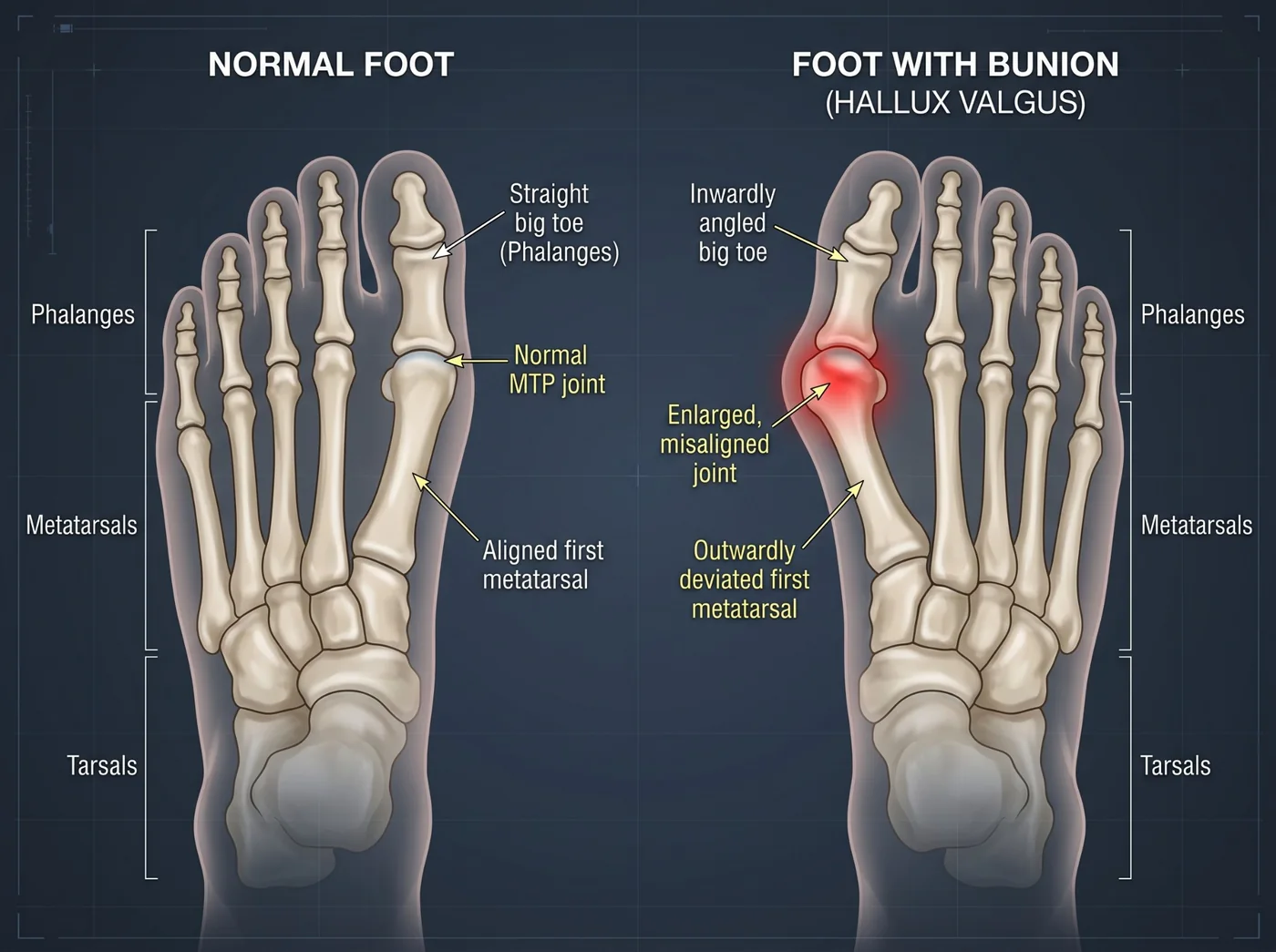
People with bunions, hammertoes, or a naturally wide forefoot often find extra toe room more comfortable, because there's less pressure on those spots. That's general footwear guidance, not medical advice. If you have pain, a visible deformity, numbness, or a diagnosed foot condition, a podiatrist should weigh in.
A bunion is a bony bump at the base of the big toe, where the joint shifts out of alignment and the big toe angles inward toward the other toes. Pointed shoes press on exactly that spot, which is why toe room matters so much for people who have one.
Be more cautious with the minimalist end of the spectrum if you have plantar fasciitis, Achilles or calf problems, flat feet that need support, or arthritis. For those situations, a cushioned, supportive shoe with a wide toe box is usually the better route. Our plantar fasciitis guide covers what to look for.
Common mistakes
- Sizing up in length to get toe room. It leaves extra shoe in front of your toes and a loose heel. Look for a wider shape or width instead.
- Accepting a loose heel. A roomy toe box shouldn't mean a sliding foot. Look for a snug heel and secure lacing so your foot stays put.
- Assuming dressy shoes can't have toe room. Options with rounded or square toes and soft, stretchy uppers exist, though there are fewer of them.
- Judging by the first look. Foot-shaped shoes can look unusually wide on the shelf. What matters is how they feel with your foot in them.
Want room for your toes without guessing?
Tell ShoeCompass what you need, including your activity and any foot concerns, and we'll point you toward wide toe box options that fit how you'll actually wear them.
Try ShoeCompass →